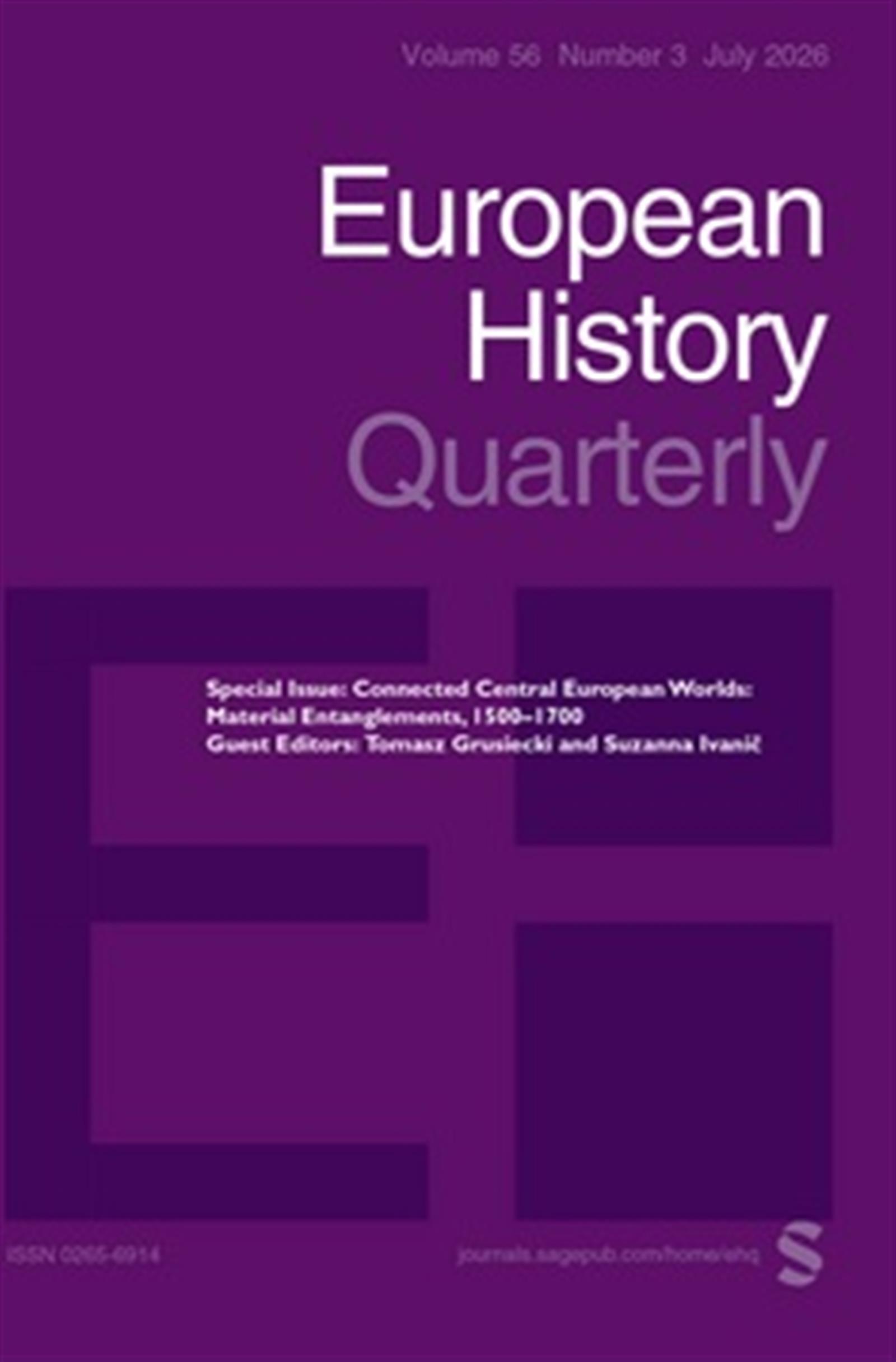

European History Quarterly Abo

Ausgabe 002/2026
Aktuelle Ausgabe

The Hotel Lux: A Communist Contact Zone in Moscow in the 1920s
The Hotel Lux in central Moscow housed communists from around the world during the 1920s. It served as a crucial political and social contact zone, enabling the formation of international and transnational networks among its residents. The living experiences and social practices of its occupants shaped the hotel into a key hub of the Communist International.

‘We are Going far Away, but Without Separating’: The International Union of Catholic Women's Leagues (1910–1939)
The International Union of Catholic Women's Leagues was the leading international Catholic women's organization. During its first three decades, it shaped debates on women's rights, Catholicism, and morality through international conferences. Positioned at the intersection of Catholic and feminist internationalism, it actively engaged with the League of Nations, pursuing cooperation and advancing concrete proposals across multiple fields.

Ausgabe 001/2026


Ausgabe 004/2025

Notarial Archives and Social Network Analysis: Ottaviano Fregoso and the Genoese Consulate in Seville
This paper uses Social Network Analysis of notarial records to study the Genoese “merchant nation/guild” in southern Castile around 1500. Focusing on a 1520 letter from Governor Ottaviano Fregoso to Genoese merchants in Seville, it asks why only 20 received it. The article argues that dense commercial networks enabled fast communication but also challenged the guild’s formal structure.

‘I am Just a Walking Letterbox in Which They Deposit Their Complaints’: Being a Spanish Delegate for the Inspection of German Prisoner of War Camps During the First World War (1917–1919)
This article examines Spanish delegates’ roles in protecting Allied prisoners of war in Germany between 1917 and 1919. Drawing on newly discovered archives, it explores how these neutral intermediaries observed German society under wartime strain. Their correspondence reveals that humanitarian work intertwined with personal ambitions and expectations of symbolic and material rewards, shaping their actions and concerns.

Ausgabe 003/2025

Trailblazing the Transition: Moving Beyond Limits to Growth in the Netherlands During the Long 1970s
In the 1970s, the environmental debate in the Netherlands challenged the supremacy of the growth paradigm. The dispute culminated in the ‘Selective Growth Memorandum’ in 1976, which was intended to unite environmental and economic goals. Although it adhered to the growth model, it discursively prepared the ground for ecological modernisation.

‘Many Modern Industrial Spies are Excellent Scholars’: Industrial Counterespionage and Images of Knowledge in Czechoslovakia During the Great Depression
The article examines how security-oriented images of knowledge gained importance in interwar Czechoslovakia. Using industrial counterespionage, it links ideological demands with shifting views on corporate research and traces state interventions, especially during the Great Depression, culminating in restricted technology transfer and expert debates on the 1935 Economic Espionage Act.

Mehr anzeigen

Porträt von European History Quarterly

European History Quarterly veröffentlicht Artikel zur europäischen Geschichte vom Spätmittelalter bis zur Zeit nach 1945. Sie deckt ein breites Spektrum historischer Themen ab und richtet sich an Historiker und Wissenschaftler im Bereich der europäischen Geschichte.
Weniger anzeigen

European History Quarterly Abo

Abonnement

Wählen Sie Ihr Abo

Wann soll geliefert werden?

Wohin soll geliefert werden?
Ausgabe
002/2026
Aktuelle Ausgabe

The Hotel Lux: A Communist Contact Zone in Moscow in the 1920s
The Hotel Lux in central Moscow housed communists from around the world during the 1920s. It served as a crucial political and social contact zone, enabling the formation of international and transnational networks among its residents. The living experiences and social practices of its occupants shaped the hotel into a key hub of the Communist International.

‘We are Going far Away, but Without Separating’: The International Union of Catholic Women's Leagues (1910–1939)
The International Union of Catholic Women's Leagues was the leading international Catholic women's organization. During its first three decades, it shaped debates on women's rights, Catholicism, and morality through international conferences. Positioned at the intersection of Catholic and feminist internationalism, it actively engaged with the League of Nations, pursuing cooperation and advancing concrete proposals across multiple fields.

Ausgabe
001/2026


Ausgabe
004/2025

Notarial Archives and Social Network Analysis: Ottaviano Fregoso and the Genoese Consulate in Seville
This paper uses Social Network Analysis of notarial records to study the Genoese “merchant nation/guild” in southern Castile around 1500. Focusing on a 1520 letter from Governor Ottaviano Fregoso to Genoese merchants in Seville, it asks why only 20 received it. The article argues that dense commercial networks enabled fast communication but also challenged the guild’s formal structure.

‘I am Just a Walking Letterbox in Which They Deposit Their Complaints’: Being a Spanish Delegate for the Inspection of German Prisoner of War Camps During the First World War (1917–1919)
This article examines Spanish delegates’ roles in protecting Allied prisoners of war in Germany between 1917 and 1919. Drawing on newly discovered archives, it explores how these neutral intermediaries observed German society under wartime strain. Their correspondence reveals that humanitarian work intertwined with personal ambitions and expectations of symbolic and material rewards, shaping their actions and concerns.

Ausgabe
003/2025

Trailblazing the Transition: Moving Beyond Limits to Growth in the Netherlands During the Long 1970s
In the 1970s, the environmental debate in the Netherlands challenged the supremacy of the growth paradigm. The dispute culminated in the ‘Selective Growth Memorandum’ in 1976, which was intended to unite environmental and economic goals. Although it adhered to the growth model, it discursively prepared the ground for ecological modernisation.

‘Many Modern Industrial Spies are Excellent Scholars’: Industrial Counterespionage and Images of Knowledge in Czechoslovakia During the Great Depression
The article examines how security-oriented images of knowledge gained importance in interwar Czechoslovakia. Using industrial counterespionage, it links ideological demands with shifting views on corporate research and traces state interventions, especially during the Great Depression, culminating in restricted technology transfer and expert debates on the 1935 Economic Espionage Act.

Mehr anzeigen

Porträt von European History Quarterly

European History Quarterly veröffentlicht Artikel zur europäischen Geschichte vom Spätmittelalter bis zur Zeit nach 1945. Sie deckt ein breites Spektrum historischer Themen ab und richtet sich an Historiker und Wissenschaftler im Bereich der europäischen Geschichte.
Weniger anzeigen
Leserbewertungen
1 Jahr Freude schenken!
Bei einer Auswahl von über 1.800 Magazinen finden Sie das richtige Geschenk für jeden.
Newsletter abonnieren
Jede Woche Informationen zu Magazinen, Trends, Gutscheinen, Aktionen und Angeboten von Presseshop. Alles direkt in Ihrem Posteingang.
Newsletter Bild

In der aktuellen Ausgabe von European History Quarterly

  • The Hotel Lux: A Communist Contact Zone in Moscow in the 1920s
    The Hotel Lux in central Moscow housed communists from around the world during the 1920s. It served as a crucial political and social contact zone, enabling the formation of international and transnational networks among its residents. The living experiences and social practices of its occupants shaped the hotel into a key hub of the Communist International.
  • ‘We are Going far Away, but Without Separating’: The International Union of Catholic Women's Leagues (1910–1939)
    The International Union of Catholic Women's Leagues was the leading international Catholic women's organization. During its first three decades, it shaped debates on women's rights, Catholicism, and morality through international conferences. Positioned at the intersection of Catholic and feminist internationalism, it actively engaged with the League of Nations, pursuing cooperation and advancing concrete proposals across multiple fields.
  • The Puzzle of Political Participation in Modern Europe: New Perspectives on an Old Phenomenon
    Political participation is not a linear progression toward inclusion but a continuously contested concept. Who counts as a citizen, which forms of participation are legitimate, and which institutions are involved have been negotiated throughout history. Case studies from the Netherlands, Spain, Italy, and other European states demonstrate that debates over participation persisted well beyond universal suffrage and the formation of modern nation-states.
Newsletter
Kontakt